
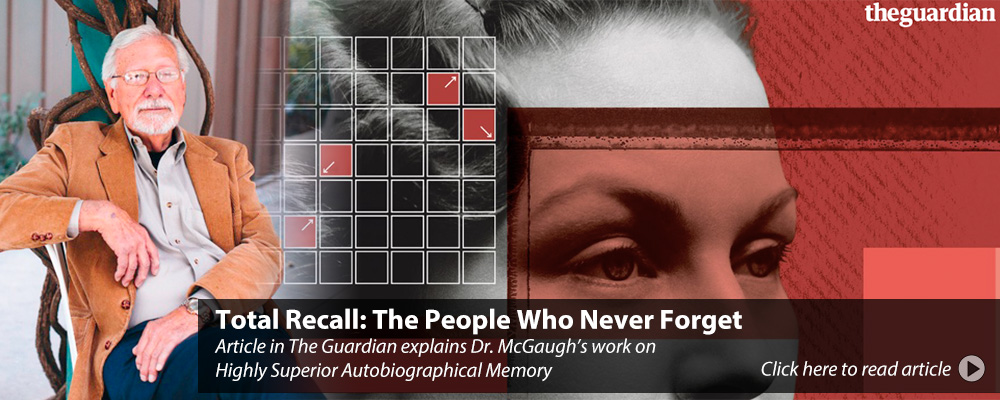
Highly Superior Autobiographical Memory (HSAM) is a memory phenomenon first described by researchers at the Center for the Neurobiology of Learning and Memory at UC Irvine. Individuals with HSAM have a superior ability to recall specific details of autobiographical events, tend to spend a large amount of time thinking about their past and have a detailed understanding of the calendar and its patterns.
Initial Discovery: In 2006, Professor James McGaugh and colleagues reported the first known case of HSAM in a research participant known as “AJ”, later identified as Jill Price. When provided with a date, Jill could specify on which day of the week it fell and what she did that day. Since then, more individuals with this extraordinary ability have been identified (over 50 now), and CNLM researchers have been working to understand this mysterious ability. The condition was renamed to HSAM from its original label, hyperthymesia, which was used in the original report. Read all of the scientific reports here. The phenomenon and the work have been highlighted in numerous media venues.
Where we stand: So far, a number of other individuals have been identified with similar abilities and a number of other research groups have begun to explore this phenomenon. Memory for public events has typically been used as a screening criterion which is then followed by more rigorous memory testing. However, it is now clear that these tests rely heavily on expertise as well as the age of the participant. There is also a strong cultural bias in the questions typically asked.
Currently, UC Irvine's Translational Neuroscience Laboratory lead by Dr. Michael Yassa is developing new tools to probe this phenomenon that do not rely on individual expertise or explicit knowledge of public events. Please visit the lab's website here to learn more and take a screening.
For more information, please contact yassalabresearch@uci.edu